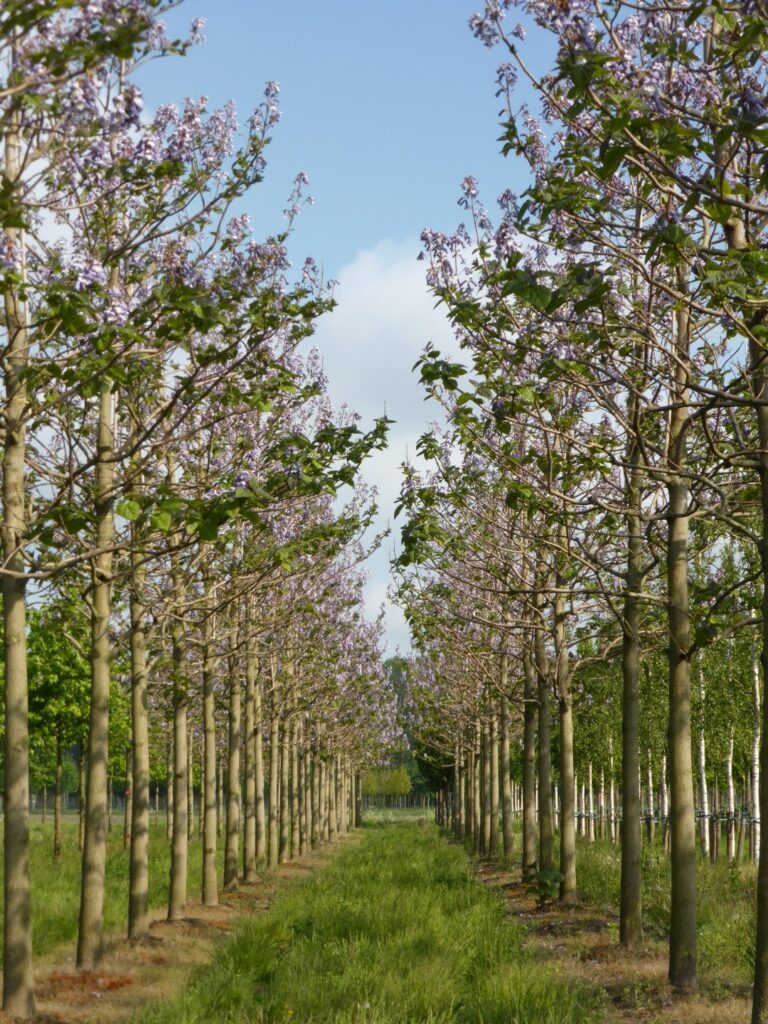
What is Paulownia?
Big Branch Africa is emerging as one of the leading pioneers introducing structured Paulownia cultivation across Africa, particularly in East Africa.
Through research partnerships, international propagation networks, and demonstration farms, Big Branch Africa is working to establish Paulownia as a climate-smart forestry solution that can transform how land is used across the continent.
The organization focuses on:
• Introducing high-performance Paulownia hybrids suited for African climates
• Establishing demonstration plantations and farmer training programs
• Supporting agroforestry models that combine timber, honey production, fodder, and crops
• Enabling carbon credit opportunities through regenerative tree planting
• Creating new timber value chains for African markets and exports
With Africa facing rising demand for timber, pressure on natural forests, and increasing climate challenges, Paulownia offers a powerful alternative. The tree grows rapidly, regenerates after harvest, improves soil quality through its deep root system, and absorbs significant amounts of carbon dioxide during its growth cycle.
Paulownia Products and Wood Properties
Through its agroforestry initiatives, Big Branch Africa is introducing Paulownia as a high-value timber species capable of supporting sustainable forestry and new wood industries across Africa. The exceptional qualities of Paulownia wood make it suitable for a wide range of commercial and construction applications while maintaining strong environmental benefits.
Paulownia timber is known for its clean grain structure and minimal knots, which significantly reduces processing waste during milling. This characteristic makes it highly attractive to manufacturers, furniture makers, and timber buyers looking for consistent, high-quality wood.
One of the most notable advantages of Paulownia is its lightweight structure combined with strong performance. The wood has a dry density of approximately 260 kg/m³, making it considerably lighter than many conventional hardwoods while still maintaining excellent strength relative to its weight.
From a structural perspective, Paulownia demonstrates impressive mechanical properties. It has an elasticity modulus of approximately 5.6 GPa and a modulus of rupture of around 28 MPa, which provides good load resistance despite its light weight. This balance between strength and low density makes Paulownia particularly suitable for applications where weight reduction is important.
Another important quality is its dimensional stability. The wood has very low shrinkage coefficients compared to many timber species, with contraction values of approximately 0.094 radial, 0.268 tangential, and 0.362 volumetric. These properties mean that Paulownia lumber maintains its shape well during drying and long-term use, reducing warping or cracking.
Paulownia also offers excellent thermal insulation properties. Its thermal conductivity is extremely low, at approximately 0.07 kcal/m/hour/°C, allowing it to retain heat more effectively than many other building materials such as brick, concrete, or steel. This makes it valuable in construction and interior applications where insulation is important.
In addition, paulownia wood has a very high resistance to heat and ignition. Its auto-ignition temperature is around 400°C, which is nearly double that of many common hardwood species that ignite at around 220°C.
The wood is also naturally resistant to insects and decay. Research indicates that Paulownia is generally not attractive to termites, and any deterioration in untreated timber tends to occur only on the surface rather than deep structural damage.
Another advantage is the non-resinous sap found in Paulownia. Because the wood does not contain resin, finishing products, solvents, and adhesives interact cleanly with the timber. This allows for high-quality finishing, polishing, painting, and coating, making it ideal for furniture and decorative wood products.
When used outdoors above ground level, Paulownia demonstrates durability comparable to Western Red Cedar. With proper sealing using water-repellent coatings, it can maintain long-term performance in exterior applications.
Finally, one of the defining characteristics of Paulownia wood is its ease of processing. It is simple to cut, shape, nail, screw, glue, and polish. The wood typically does not split, chip, or crack during carpentry processes, allowing manufacturers to work with it efficiently.
Through the work of Big Branch Africa, Paulownia is being positioned not only as a fast-growing forestry crop but also as a premium sustainable timber resource capable of supporting furniture manufacturing, construction materials, interior design, and export markets across Africa.
Paulownia Plantations
At Big Branch Africa, Paulownia plantations are being introduced as a new model of sustainable agroforestry in Africa. Beyond its value as a fast-growing timber species, Paulownia offers environmental, economic, and agricultural benefits that make it ideal for large-scale regenerative land use.
A Tree That Combines Beauty and Productivity
Paulownia is not only a commercial forestry crop but also a visually striking tree. Each year it produces beautiful purple blossoms that bloom before the leaves appear, making plantations attractive landscapes while still serving as productive agricultural assets.
Regrowth Without Replanting
One of the most remarkable characteristics of Paulownia is its ability to regenerate from the same root system after harvesting. A single tree can typically be harvested between three and five times from the original planting cycle. This reduces the need for repeated replanting and significantly lowers long-term plantation costs.
Powerful Carbon Absorption
Paulownia trees grow large leaves very quickly, allowing them to absorb substantial amounts of carbon dioxide from the atmosphere. A plantation can absorb approximately 60 tons of CO₂ per hectare per year, contributing to climate mitigation efforts and creating opportunities for carbon credit projects.
Supporting Honey Production
Paulownia flowers are also highly attractive to bees. A healthy plantation can support honey production of approximately 700 kg per hectare, creating additional income opportunities for farmers through beekeeping and honey production.
Improving Soil Health
Unlike many intensive crops, Paulownia plantations do not degrade the soil. In fact, the trees improve soil structure and fertility. Their large leaves fall and decompose, returning organic matter and nutrients to the ground.
The tree also develops a deep taproot system reaching 10–12 meters, which stabilizes soil and helps prevent erosion while accessing nutrients and water from deeper layers of the ground.
Non-Invasive Hybrid Varieties
The Paulownia hybrids introduced through Big Branch Africa are sterile and noninvasive, meaning they cannot spread uncontrollably through seeds. This ensures responsible plantation management and environmental protection.
Agricultural Crop Flexibility
Another key advantage of Paulownia plantations is that they function as agricultural crops rather than traditional forest trees. This means harvesting can be managed according to agricultural cycles rather than long forest regulations, allowing growers greater flexibility in plantation management.
A Renewable Bioenergy Resource
In addition to timber and honey production, Paulownia can also contribute to renewable bioenergy solutions. The biomass produced by the trees can be used as a sustainable source of biofuel, helping support global efforts toward cleaner energy alternatives.
Through its plantation programs, Big Branch Africa is building a new generation of climate-smart forestry systems that combine timber production, carbon capture, soil restoration, and agricultural income streams.
Paulownia plantations represent more than just tree farming.
They represent a sustainable future for land, farmers, and the environment across Africa.